The aliment system of elder support
The PeasantsThe aliment system of elder support is the arrangement by which an older person who has signed property over to relatives depends on them for care and sustenance. In the case of Agata, that dependence does not secure a stable place in the family home: she is taken in during summer, then leaves to beg as winter approaches. The system makes land transfer inseparable from the right to live, while allowing relatives’ need for an elder’s labor and shelter to determine when she belongs among them.
The Arrangement and Its Cost
Agata’s situation is presented as an example of the cruel aliment law. After signing her property over to her children, she is driven out to beg and earn a living to pay her relatives for her care in old age. The sequence matters: property has already passed out of her hands, while her continued support depends on the people who received it. The arrangement therefore leaves her without the security that ownership once gave her and makes the provision she receives conditional on her usefulness and the household’s circumstances.
The account does not describe a single, uninterrupted expulsion. Agata explains that the Kłąbs take her in when summer comes, and she rejects the suggestion that they have turned her out in a quarrel. Instead, she says she saw that it was time to leave. Her departure is framed as a response to scarcity and her sense of her place among kin, not as a dispute that can be settled by reconciliation. Her own explanation makes plain how a person may participate in her removal when the available choices have already been narrowed by dependence.
Agata’s Seasonal Exile
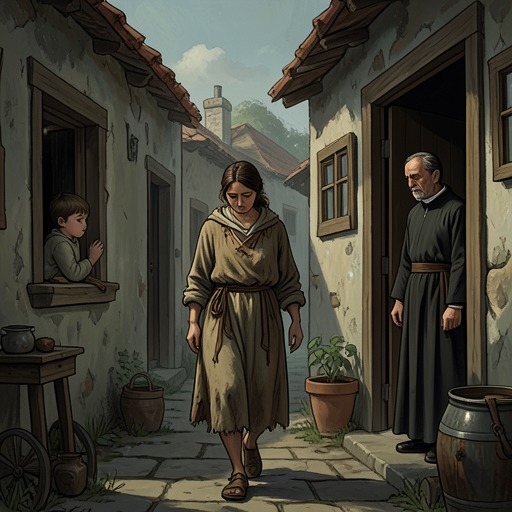
Winter’s approach gives the arrangement its recurring shape. Agata asks whether she is to receive food and a place to sleep for nothing, while the household must make room for a young bullock separated from its mother and for goslings sheltered from the cold. She insists that these animals, too, are God’s creatures. Her account places her need alongside the care of livestock, but also shows the household’s practical priorities: with cold weather coming, space and resources are allocated to the animals, while the older woman goes out into the world to seek alms.
Agata describes this departure in terms of small economies rather than a secure provision. She says she needs little and trusts that charitable people will give her enough to struggle through until spring. She hopes to save a grosz or two before the harvest, money that will be useful to her relatives, who remain kin. The detail does not erase her hardship; it reveals how she tries to make her poverty compatible with family obligation, imagining even the small amount she can save as something she can return to them. Her appeal to Jesus’ mercy expresses faith, but also the absence of any dependable guarantee that she will be fed or sheltered.
Kinship, Labor, and Belonging
Agata’s saying, “Better land on your own feet in a puddle than crowd another’s cart,” gives her departure the force of a rule for survival. She would rather endure exposure than make herself an apparent burden on her relatives. Yet her own account complicates the idea that she simply leaves by choice: she says there is no more work for her, and winter is coming. Kinship gives her a summer refuge, but it does not protect her from being displaced when household labor, animals, and provisions compete for room.
The system thus binds elder support to land and labor. Agata’s earlier transfer of property has left her reliant on the family that received it; her continuing presence is described through work, food, sleeping space, and the needs of the farm. The novel does not present her predicament as a private misunderstanding between relatives. It identifies the aliment arrangement itself as ruthless in the way it links ownership of land to the right to life. Her seasonal movement makes that connection visible: she is kin in summer, yet must seek alms in winter.
Charity and the Limits of Relief
The Parish Priest encounters Agata as she is leaving to beg and pushes a zloty diffidently into her hand. She blesses him for it, and the exchange registers real compassion. But the donation is a momentary intervention, not a change in the conditions that have put her on the road. The novel’s account stresses that occasional philanthropy does not alter the world’s arrangement; it can even reinforce it by easing immediate suffering while leaving the underlying dependence intact.
Agata is not the only figure associated with victimhood under the aliment system. Jagustynka is also described as one of its victims, though the account does not give her circumstances in the same detail. Together, their presence connects the system to a wider order in which access to land and the protection it affords are unevenly held. Agata’s case is especially stark because its consequences recur with the seasons: after transferring her property, she must leave the household when winter closes in, rely on strangers’ alms, and hope to reach spring. The arrangement offers care in name, but her lived experience exposes how little security that promise may contain.